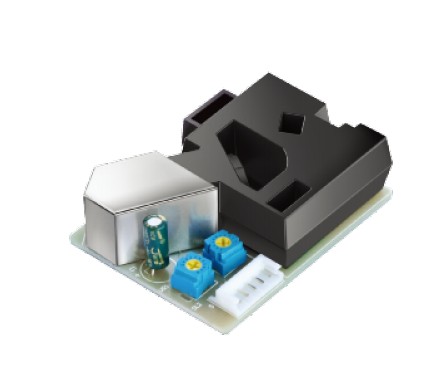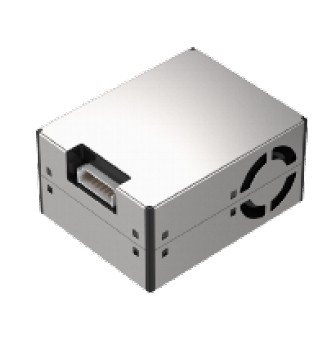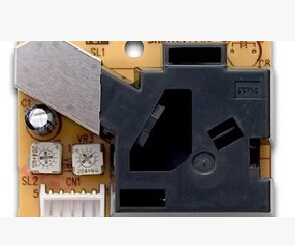

Dust Sensor - PPD4NS/ PD42NS/ PPD42NJ
1. Optical principle, capable of detecting dust particles larger than 1 micron;
2. Two output modes to meet different sensitivity requirements, clean environment Vout outputs high-level signal (4V);
3. 5VDC power supply;
4. Detection particle range: up to 8000pcs/283ml (particles above 1um);
5. Origin: Japan Shinyei
Product Introduction
Product name:Dust sensor
Model: PPD4NS/ PD42NS/ PPD42NJ
I.Dust sensor PPD4NS/ PD42NS/ PPD42NJProduct information introduction
1. Optical principle, capable of detecting dust particles larger than 1 micron;
2. Two output modes to meet different sensitivity requirements, clean environment Vout outputs high-level signal (4V);
3. 5VDC power supply;
4. Detection particle range: up to 8000pcs/283ml (particles above 1um);
II.Dust sensor PPD4NS/ PD42NS/ PPD42NJMain features
1. PWM output mode;
2. Compact structure and light weight;
3. Easy to install;
4. Single power supply;
5. Low cost. Low-cost dust sensor PD4NS, with a lifespan of over 15 years.
III.Dust sensor PPD4NS/ PD42NS/ PPD42NJMain applications
1. Air purifiers and air fresheners;
2. Air conditioning;
3. Air quality monitor;
4. Related products such as air conditioning.
IV.Dust sensor PPD4NS/ PD42NS/ PPD42NJCharacteristics of
--- Dust sensor can sense smoke particles from tobacco, pollen, and tiny particles above 1 micron such as household dust.
--- Small size, light weight, easy to install.
--- 5V input circuit, convenient for signal processing.
--- Built-in airflow generator, can automatically draw in external air.
--- Dust sensor is easy to maintain and can maintain the sensor's characteristics for a long time.
V.Dust sensor PPD4NS/ PD42NS/ PPD42NJThe principle of
Particles and molecules produce light scattering when illuminated by light, and at the same time, they absorb part of the energy of the incident light. When a parallel
When a parallel monochromatic light is incident on the particle field to be measured, it is affected by scattering and absorption around the particles, and the light intensity will be attenuated. In this way,
The relative attenuation rate of the incident light passing through the concentration field to be measured can be obtained. The relative attenuation rate can basically linearly reflect the dust in the field to be measured.
The relative concentration. The intensity of light is proportional to the strength of the electrical signal after photoelectric conversion. By measuring the electrical signal, the relative attenuation rate can be obtained.
Attenuation rate.
Six,Dust sensor PPD4NS/ PD42NS/ PPD42NJThe main parameters
1. Optical principle, capable of detecting dust particles larger than 1 micron;
2. Two output modes to meet different sensitivity requirements, clean environment Vout outputs high-level signal (4V);
3. 5VDC power supply;
4. Detection particle range: up to 8000pcs/283ml (particles above 1um);