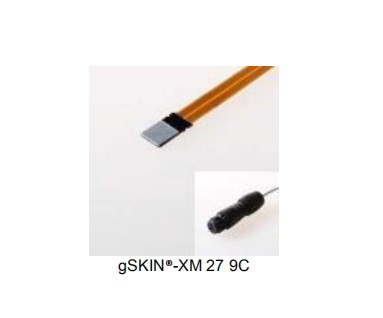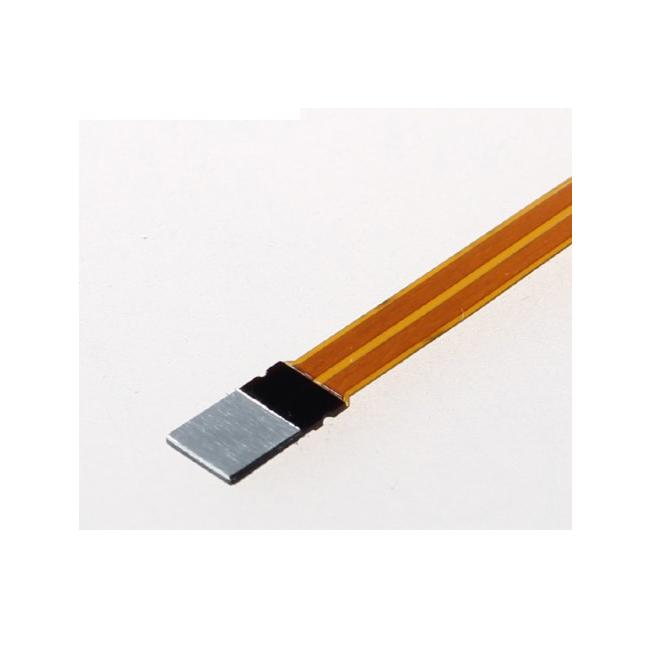


Swiss greenTEG Heat Flux Sensor - gSKIN-XM
Ultra-high resolution heat and temperature difference
Low intrusiveness and thickness
Models with connectors compatible with all gSKIN® DLOG data loggers
All sensors with conduction heat flux calibration compliant with ISO 8301
Product Introduction
Swiss greenTEG Heat Flux Sensor gSKIN-XM Description:
Our technology is based on the GSKIN thermopile sensor gSKIN-XI technology developed by greenTEG at ETH Zurich, Switzerland.
gSKIN®The heat flux sensor uses 29 pairs of ultra-high sensitivity thermocouples to measure the heat flux through the sensor's own surface. The sensor has an area of 72 mm² and a thickness of 0.4 mm. Level-0 packaging optimizes polymer and level-1 packaging for metal structures.
Heat Flux Sensor:
Dimensions: 18mm x 18mmResolution: 0.03 W/m²2-9μW-10μK
Calibration: Sensors are calibrated in steady state in accordance with ISO 8301. Sensors are calibrated at an average temperature of 22.5°C. Each gSKIN® heat flux sensor is shipped with a calibration certificate containing the calibration coefficient.
Swiss greenTEG Heat Flux Sensor gSKIN-XM Features:
Ultra-high resolution heat and temperature differenceLow intrusiveness and thickness
Models with connectors compatible with all gSKIN®DLOG data loggers
All sensors with conduction heat flux calibration compliant with ISO 8301
Swiss greenTEG Heat Flux Sensor gSKIN-XM Applications:
R&D departmentsThermal optimization
Energy efficiency
Industrial monitoring of thermal performance
Also particularly suitable for the following fields:
Textile/Textile Industry
- Enhance the value of textiles by increasing comfort and optimizing thermal resistance/transmission. The very thin design allows measurements in dynamic environments.
Building Technology:
- Provide customers with suitable building materials through in-situ/ex-situ heat flux measurements and more precise thermal resistance (R-Values).
- Increase building energy efficiency by measuring heat flux through building structures and using heat flux measurements in automatic heating and ventilation control systems.
- Optimize and understand heat transfer from solar modules to buildings.
Experimental Setups (Equipment)
- Characterize and optimize chemical processes from the perspective of temperature, volumetric heat output, addition rate, hold time, and reaction rate;
Heat profiling, heat transfer, chemical conversion, and heat transfer under similar conditions in industrial engineering;
Real-time measurement of heat release;
Integrate into measurement devices.
Automotive Industry:
- Maximize comfort of automotive materials (e.g., seat fabrics), optimize heating system efficiency, and enhance customer driving experience.
- Improve overall vehicle efficiency by measuring and controlling heat release from combustion and mechanical processes.
Electronics Industry:
- Measure heat release and heat flux of IC chips to develop and monitor proper functionality.
Process Equipment and Plant Manufacturing
- Improve plant safety and efficiency by measuring heat flux values that enable smart condition monitoring.
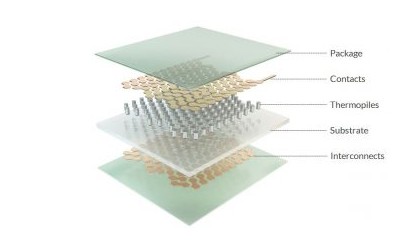
Due to the Seebeck effect, greenTEG's gSKIN sensors measure heat flow. The sensitivity of this sensor depends on the thermocouples used, their number, quality, and construction. Standard thermocouples are divided into two different temperature differences: n-type and p-type semiconductors.
GSKIN thermocouples based on BiTe (Bismuth Telluride) technology provide optimal sensitivity. These thermocouples are integrated into a special patented construction using high-quality substrates to enhance their efficiency.
Furthermore, this architecture allows for very thin and robust sensors.
Measurement Principle
The heat flux sensor generates a voltage signal proportional to the heat flowing through the sensor. The output voltage (in microvolts) is proportional to the heat flux (in W/m²), depending on the sensor sensitivity given in µV/(W/m²).
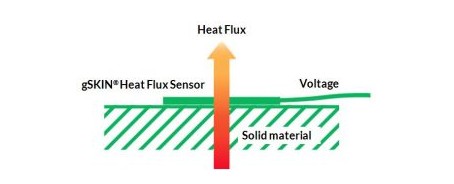
Since the output is in microvolts, the signal must be amplified by an A/D converter to achieve good resolution. The accuracy of the sensor will mainly depend on this parameter.
Swiss greenTEG Heat Flux Sensor gSKIN-XM Model Parameters:
| Model |
XM 26 9C |
XM 27 9C |
Xp 26 9c |
Xp 27 9c |
XI 26 9c |
XI 27 9c |
XO 67 7c |
XO-66 7C -Temp |
|
| Product Number |
A-044336 |
A-044339 |
A-044573 |
A-044577 |
A-044628 |
A-044630 |
A-044717 |
A-044728 |
|
| Detector Type |
Thermopile
|
Thermopile
|
Thermopile
|
Thermopile
|
Thermopile / NTC
|
||||
| Surface Material (Sensing Area) |
Anodized Aluminum
|
Anodized Aluminum
|
Anodized Aluminum
|
Polyamide
|
Polyamide
|
||||
| Sensing Dimensions (a x b x d) [mm x mm x mm] |
4.4 x 4.4 x 0.5
|
10.0 x 10.0 x 0.5
|
18.0 x 18.0 x 0.5
|
30.0 x 30.0 x 3.3
|
30.0 x 30.0 x 3.3
|
||||
| Heat Flux Range Min / Max [kW/m²]2] |
-150 / 150
|
-150 / 150
|
-150 / 150
|
-15/ 15
|
-15/ 15
|
||||
| Noise Equivalent Heat Fluxa[W/m2] / Resolution [µW] |
0.34 / 6.6 |
0.05 / 5.0 |
0.02 /4.6 |
0.07 / 64.3
|
0.07 / 64.3
|
||||
| Heat Flux Resolution [W/m²]2] / Resolution [µW] gSKIN®DLOGb |
0.41 / 7.9
|
0.06 / 6.1
|
0.02 / 5.7
|
0.09 / 78.4
|
0.09 / 78.4
|
||||
| Min / AveragecSensitivity (S) [µV/(W/m²)]2)]
|
1.5 / 4.0 |
10.0 / 20.0 |
35.0 / 65.0 |
7.0 / 13.0
|
7.0 / 13.0
|
||||
| Response Timee(0-95%) [s] |
0.7
|
0.7
|
0.7
|
n/a
|
n/a
|
||||
| Operating Temperature Range Min/Max [°C] |
-50 / 150
|
-50 / 150
|
-50 / 150
|
-50 / 80
|
-50 / 80
|
||||
| Calibration Temperature Range Min/Max [°C] |
-30 / 70
|
-30 / 70
|
-30 / 70
|
-30 / 70
|
-30 / 70
|
||||
| Calibration Accuracy [±%] |
3 |
3 |
3 |
3 |
3 |
||||