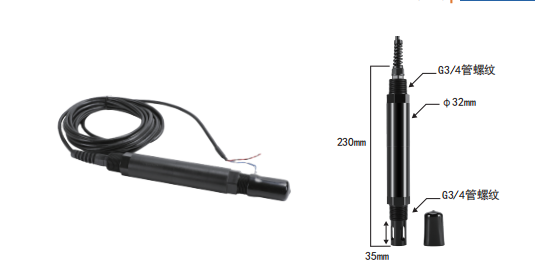
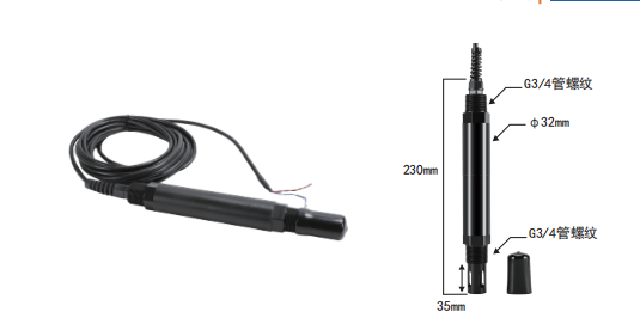
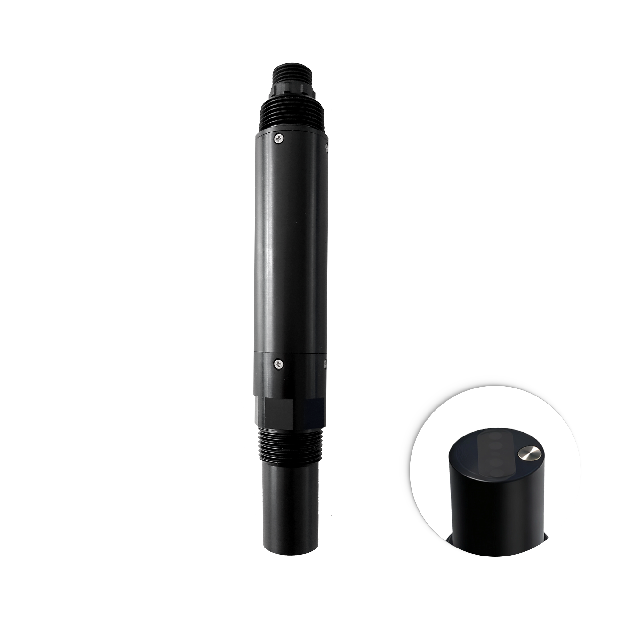
How much does an online salinity sensor cost per unit - AMT/YD-300
Range: 0-5000uS/m, 0-100000uS/em (graphite four-electrode conductivity
Resolution: 0.001mS/em
Basic error: +2%F.S
Temperature: -10-150°C
Temperature error: ±0.3°C
Automatic or manual temperature compensation range
Temperature compensation: 0~60°C
Communication output: RS485 Modbus RTU
Power supply: 9~28VDC, power: <0.2W
Product Introduction
Online-salinity-sensor
AMT/YD-300
70911001
Online salinity sensor
Measurement principle: To avoid electrode polarization, the sensor circuit generates a highly stable sine wave signal applied to the electrodes. The current flowing through the electrodes is proportional to the conductivity of the measured solution. The instrument converts the current into a voltage signal through a high-impedance operational amplifier, then after
After program-controlled signal amplification, phase-sensitive detection, and filtering, a potential signal reflecting conductivity is obtained; the microprocessor alternately samples the temperature signal and conductivity signal through switch switching, and after calculation and temperature compensation, obtains the conductivity of the measured solution at 25°C
value and the temperature value at that time.
Temperature compensation principle: The conductivity of electrolyte solutions is affected by temperature changes and requires temperature compensation. The temperature coefficient of weak aqueous solutions is 2.00%/°C; the higher the concentration, the smaller the temperature coefficient. For lower concentration (1µS·cm-1) solutions
The temperature coefficient does not use 2.00%/°C, but is set by the user, with a range of 0.00~9.99%.
Range: 0-5000uS/m, 0-100000uS/em (graphite four-electrode conductivity
Resolution: 0.001mS/em
Basic error: +2%F.S
Temperature: -10-150°C
Temperature error: ±0.3°C
Automatic or manual temperature compensation range
Temperature compensation: 0~60°C
Communication output: RS485 Modbus RTU
Power supply: 9~28VDC, power: <0.2W
Main Application Areas
- Industrial Water Treatment — Continuous monitoring of salinity and conductivity in boiler feedwater, cooling water, and wastewater treatment processes.
- Environmental Monitoring — Real-time salinity measurement in rivers, lakes, and seawater for pollution control and ecological studies.
- Chemical Processing — Monitoring conductivity in chemical reactors and pipelines to ensure product quality and process safety.
- Agriculture — Soil salinity and irrigation water monitoring to optimize crop yield and prevent soil degradation.
- Aquaculture — Salinity control in fish farms and shrimp ponds to maintain optimal aquatic life conditions.
Keywords:online salinity sensor, salinity meter, conductivity sensor, water quality sensor, industrial salinity sensor, RS485 salinity sensor, salinity transmitter, inline salinity monitor