

Netherlands Smartec Ultra-Low-Power High-Precision Digital Output Temperature Sensor - SMT172
Most energy-efficient temperature sensor:
Only 0.36µJ consumed per measurement (TA =25°C, 3.3V)
Wide temperature range: -45°C to 130°C
Wide operating voltage range: 2.7V to 5.5V
High accuracy: ±0.25°C (-10°C to 100°C TO18)
±0.1°C (-20°C to 60°C, TO18)
Ultra-low noise: 0.002°C (measurement time 3.6ms)
Ultra-low supply current (60µA in continuous operation,
average 220nA for one measurement per second)
Excellent long-term stability
Direct interface with microprocessors
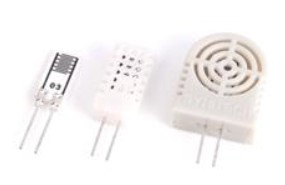
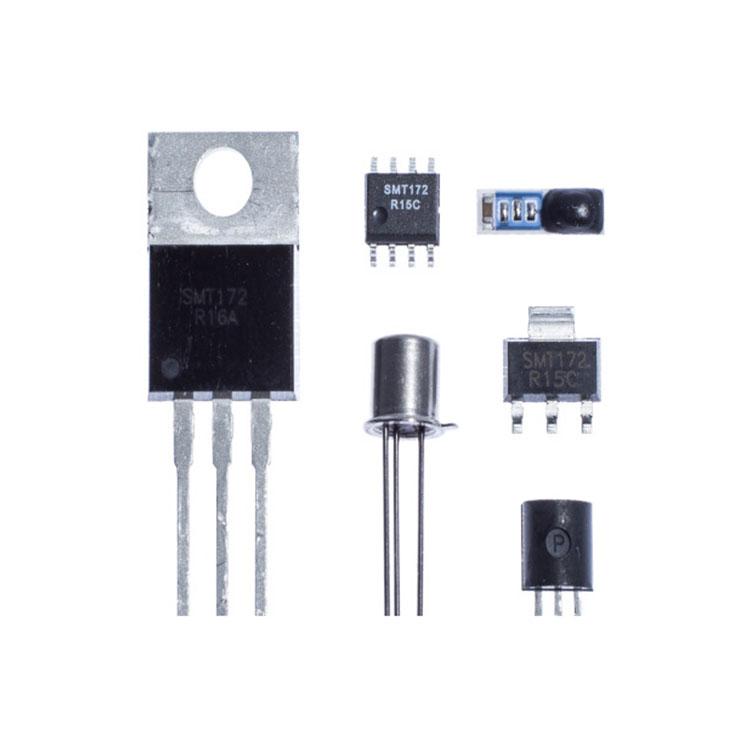
Multiple package options
Product Introduction
1. Description of Netherlands Smartec Ultra-Low-Power High-Precision Digital Output Temperature Sensor SMT172:
SMT172It is a new ultra-low-power, high-precisiondigital output temperature sensor.Its performance is stable, easy to use, and has a wide temperature measurement range. It is a single-chip silicon integrated circuit that applies new design principles and uses high-precision single-temperature-point calibration, achieving an accuracy of ±0.25°C over the range of -10°C to 100°C.
The SMT172 operates over a voltage range of 2.7V to 5.5V. At 3.3V, the supply current in continuous operation is 60µA, and the measurement speed can be up to 4000 effective readings per second (at room temperature). The extremely low measurement noise makes this sensor the most energy-efficient temperature sensor (only 0.36µJ of energy consumed per measurement).
The SMT172 output is a pulse-width modulated signal whose duty cycle is proportional to the measured temperature. This allows the temperature sensor to interface directly with a microprocessor without the need for additional analog-to-digital conversion circuits. Currently, even low-cost microprocessors generally have high-frequency timers that can quickly and accurately read the time interval of the pulse signal to obtain the duty cycle information. For users, this allows for a quick transition from development to market.
2. Features of Netherlands Smartec Ultra-Low-Power High-Precision Digital Output Temperature Sensor SMT172:
Most energy-efficient temperature sensor:
Only 0.36µJ consumed per measurement (TA =25°C, 3.3V)
Wide temperature range: -45°C to 130°C
Wide operating voltage range: 2.7V to 5.5V
High accuracy: ±0.25°C (-10°C to 100°C TO18)
±0.1°C (-20°C to 60°C, TO18)
Ultra-low noise: 0.002°C (measurement time 3.6ms)
Ultra-low supply current (60µA in continuous operation,
average 220nA for one measurement per second)
Excellent long-term stability
Direct interface with microprocessors
Multiple package options
3. Applications of Netherlands Smartec Ultra-Low-Power High-Precision Digital Output Temperature Sensor SMT172:
Ultra-low-power applications: portable electronic devices, wireless sensor networks
Medical applications: body temperature testing, body temperature monitoring
Instrument applications: (medical) chemical analysis, high-precision instruments
Environmental monitoring (indoor/outdoor)
Industrial applications: process monitoring/control
4. Parameters of Netherlands Smartec Ultra-Low-Power High-Precision Digital Output Temperature Sensor SMT172
| Parameter |
Min |
Typ |
Max |
Unit |
Conditions |
| Supply Voltage |
2.7 |
|
5.5 |
V |
|
| Supply Current |
|
50 |
|
μA |
TA = -45°C, Vcc = 2.7V, No load on output pin |
| |
60 |
|
μA |
TA = 25°C, Vcc = 3.3V, |
|
| |
70 |
|
μA |
TA = 25°C, Vcc = 5.5V, |
|
| Average Current |
|
220 |
|
nA |
TA = 25°C, Vcc = 3.3V, one measurement per second |
| Power-down Current |
|
0 |
|
μA |
Controlled via Vcc pin |
| Accuracy TO18 |
|
0.25 |
|
°C |
-10°C to 100 °C |
| |
0.8 |
|
°C |
-45°C to 130 °C |
|
| |
0.1 |
|
°C |
-20°C to 80°C (second-order relationship) |
|
| |
0.4 |
|
°C |
-45°C to 130°C (second-order relationship) |
|
| Accuracy TO92/TO220 SOT223 |
|
0.35 |
|
°C |
-10°C to 100 °C |
| |
1 |
|
°C |
-45°C to 130 °C |
|
| |
0.25 |
|
°C |
-20°C to 80°C (second-order relationship) |
|
| |
0.8 |
|
°C |
-45°C to 130°C (second-order relationship) |
|
| Measurement Time |
|
1.8 |
|
ms |
TA = 25°C, Vcc = 3.3V, 8 periods |
| Noise4 |
|
|
<0.0002 |
°C |
TA = 25°C, Vcc = 5V, 1s measurement time |
| Output Duty Cycle |
0.11 |
|
0,93 |
|
45°C to 130°C |
| Output Frequency |
0.5 |
|
7 |
kHz |
1 - 4 kHz for Vcc= 4.7-5.5 V and TA=-25°C to 110°C |
| PSRR at Vcc |
|
|
0.1 |
°C/V |
|
| Repeatability |
|
|
0.01 |
°C |
TA = 25°C, Vcc = 5V, TO18 |
| Start-up Time |
|
1 |
2 |
ms |
|
| Long-term Drift |
|
|
0.0058 |
°C |
TA = 22°C, Vcc = 5V, 365 days, TO18 |
| Output Impedance |
|
|
100 |
|
|
| Operating Temperature |
-45 |
|
130 |
°C |
|
| Storage Temperature |
-50 |
|
150 |
°C |
|
| First-order relationship between duty cycle and temperature: T = 212.77 DC - 68.085 |
|||||
| Second-order relationship between duty cycle and temperature: T = -1.43 DC2 +214.56 DC - 68.6 |
|||||