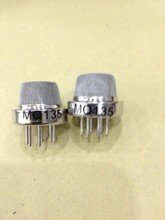

Product Introduction
-
Air Pollution Sensor MQ135 Product Description
-
The gas-sensitive material used in the MQ135 gas sensor is tin dioxide (SnO2), which has low conductivity in clean air. When polluting gases are present in the sensor's environment, the sensor's conductivity increases with the concentration of polluting gases in the air. A simple circuit can be used to convert the change in conductivity into an output signal corresponding to the gas concentration.
The MQ135 gas sensor has high sensitivity to ammonia, sulfides, and benzene series vapors, and is also ideal for monitoring smoke and other harmful gases. This sensor can detect a variety of harmful gases and is a low-cost sensor suitable for multiple applications.
-
Air Pollution Sensor MQ135Sensor Features
-
High sensitivity to ammonia, sulfides, benzene series atmospheres
Long lifespan, low cost
Simple drive circuit required
-
MainAir Pollution Sensor MQ135To Apply
-
Household air pollution alarm
Industrial air pollution alarm
Portable air pollution detector
-
Air Pollution Sensor MQ135Technical Specifications
| Product Model |
MQ135 |
||
| Product Type |
Semiconductor gas-sensitive element |
||
| Standard Package |
Bakelite (black bakelite) |
||
| Detection gas |
Ammonia, sulfides, benzene series vapors |
||
| Detection Concentration |
10-1000ppm (ammonia, toluene, hydrogen) |
||
| Standard Circuit Conditions |
Loop Voltage |
Vc |
≤24V DC |
| Heating Voltage |
VH |
5.0V±0.2V ACorDC |
|
| Load Resistance |
RL |
Adjustable |
|
| Gas-sensitive element characteristics under standard test conditions |
Heating Resistance |
RH |
31Ω±3Ω (room temperature) |
| Heating Power Consumption |
PH |
≤900mW |
|
| Surface resistance of sensitive body |
Rs |
2KΩ-20KΩ(in 100ppm NH3) |
|
| Sensitivity |
S |
Rs(in air)/Rs(100ppmNH3)≥5 |
|
| Concentration Slope |
α | ≤0.6(R100ppm/R50ppm NH3) |
|
| Standard Test Conditions |
Temperature, Humidity |
20℃±2℃;65%±5%RH |
|
| Standard Test Circuit |
Vc:5.0V±0.1V; VH: 5.0V±0.1V |
||
| Preheating Time |
No less than 48 hours |
||