
Product Introduction
Combustible Gas (Hydrocarbon) Sensor SB-11A Description:
SB-11A is a tin dioxide semiconductor gas sensor. It has excellent detection performance and high sensitivity for methane, propane, butane, and other hydrocarbons, with low power consumption (120mW). It responds quickly, has strong poisoning resistance, is insensitive to interfering gases, and is highly reliable in gas detection system applications.
Combustible Gas (Hydrocarbon) Sensor SB-11A Parameters:
Structure
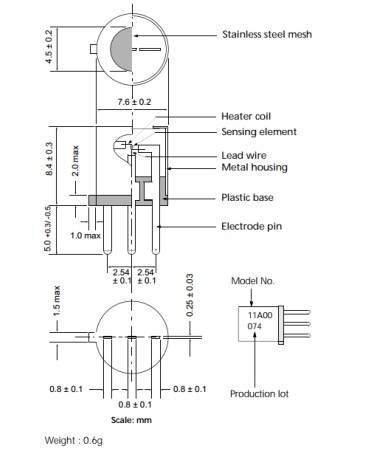
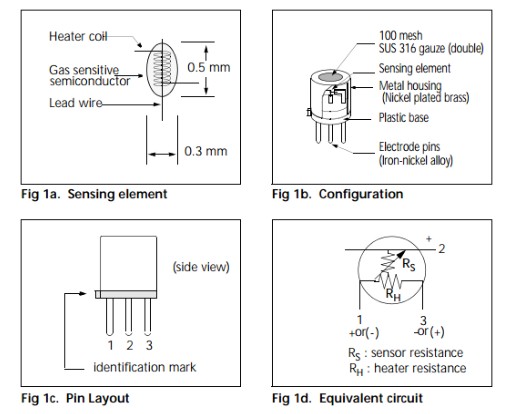
The gas sensing semiconductor element is bead-shaped, with an embedded heater coil and electrode wires. The sensing element is mounted in a metal housing with a double-layer stainless steel mesh (100 mesh) in the gas flow path. The mesh has explosion-proof properties. (Fig1)
Operating Conditions
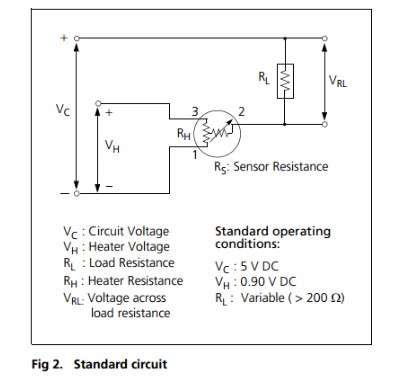
Fig2 shows the standard operating circuit for this model. The change in sensor resistance (RS) can be obtained from the change in output voltage across a fixed or variable resistor (RL). To achieve proper performance and specified characteristics, the values of heater voltage (VH), circuit voltage (Vc), and load resistance (RL) must be within the ranges specified in the standard operating conditions, as shown in the specification table on the next page.
Sensitivity Characteristics
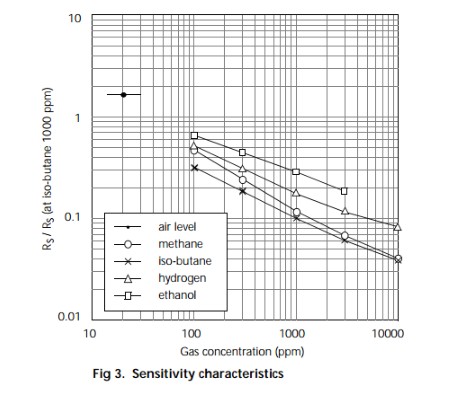
Fig3 shows the sensitivity curve of SB-11A (typical data). The sensitivity characteristics of the gas sensor are expressed by the relationship between sensor resistance and gas concentration. The increase in gas concentration is logarithmically related to the decrease in sensor resistance. The sensitivity characteristics of SB-11A are specified by the following parameters:
--Sensor resistance: in air containing 3000 ppm methane
--Sensor resistance change rate: in air containing 1000 ppm to 3000 ppm methane (slope), in air, and in air containing 3000 ppm methane
Specifications
A. Standard Operating Conditions
| Symbol |
Parameter |
Specification |
Condition |
| VH |
Heater Voltage |
0.90V ± 0.05V |
AC or DC |
| VC |
Circuit Voltage |
<5.0V |
DC: Pin 2 (+) Pin 1 (-) |
| RL |
Load Resistance |
Variable (>200Ω) |
PS<10mW |
| RH |
Heater Resistance |
2.8Ω ± 0.2Ω |
Room temperature |
| IH |
Heater Current |
130mA |
IH = VH / RH (typical) |
| PH |
Heater Power Consumption |
120mW |
PH = VH2 / RH (typical) |
| Ps |
Power Consumption of Sensing Element |
<10mW |
Ps = (Vc-VRL)2 / Rs |
B. Environmental Conditions
| Symbol |
Parameter |
Specification |
Condition |
| Tao |
Operating Temperature |
-20~50°C |
Recommended range |
| Tas |
Storage Temperature |
-20~70°C |
|
| RH |
Relative Humidity |
<95%RH |
|
| (O2) |
Oxygen Concentration |
21% ± 1% (standard condition) |
PhaseFor lower values: >18% |
| Sensitivity parameters are affected by changes in oxygen concentration. |
|||
C. Sensitivity Parameters
| Model |
SB-11A-00 |
||
| Symbol |
Parameter |
Specification |
Condition |
| RS |
Sensor Resistance |
0.2kΩ~1kΩ |
In air with 3000 ppm methane |
| β |
Sensitivity Slope |
0.48~0.68 |
RS in air with 3000 ppm methane / RS in air with 1000 ppm methane |
| γ |
Sensitivity |
≥ 8.0 |
Rs (in air) / Rs (in air with 1000 ppm isobutane) |
| ∆ |
Sensitivity |
≥ 10.0 |
Rs (in air) / Rs (in air with 3000 ppm methane) |
| Standard test conditions: Temperature: 20 °C ± 2 °C, VC: 5.0 V ± 1% |
|||
D. Mechanical Structure Parameters
| Item |
Condition |
Specification |
| Vibration |
Frequency: 100 cpm |
Should meet satisfactory specifications in sensitivity parameters |
| Shock |
Acceleration: 100G |
E. Component Materials
| No. |
Part |
Material |
| 1 |
Sensing Element |
SnO2 |
| 2 |
Wire |
Pt |
| 3 |
Sensing Element |
Pt |
| 4 |
Plastic Substrate |
Polybutylene terephthalate (PBT) |
| 5 |
Stainless Steel Mesh |
SUS316 |
| 6 |
Metal Housing |
Nickel-plated brass |
| 7 |
Electrode Pins |
Iron-nickel alloy |
Volume