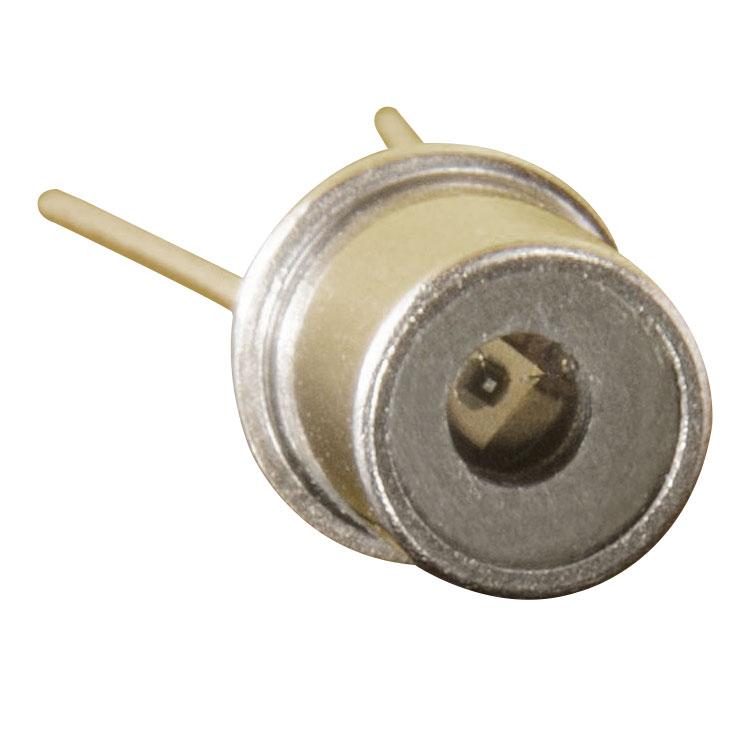

Product Introduction
Characteristics of Silicon Carbide UV Photodiode SG01S-A18:
1. Made of silicon carbide (SiC) material
2. Suitable for UVA band
3. Effective detection area 0.06mm2
4. 10mW/cm2 peak irradiance produces approximately 222nA current
5. High chip stability (certified by German PTB)
About Silicon Carbide (SiC) Material:
SiC can withstand extreme radiation hardness, nearly perfect visible blindness, low dark current, high-speed response, and low noise; these features make SiC the best material for visible-blind UV detectors. SiC detectors can operate at temperatures up to 170°C for long periods, and the temperature coefficient of the signal (responsivity) is also very low, <0.1%/K. Due to low noise (dark current at fA level), even very low UV radiation intensities can be reliably measured (with appropriate amplifiers).
SiC photodiodes can be used as unfiltered broadband detection devices or with optical filters to provide response to UVA, UVB, and UVC bands.
Technical Parameters of Silicon Carbide UV Photodiode SG01S-A18:
| Model |
SG01S-A18 |
| Spectral Characteristics |
|
| Responsivity |
0.037A/W |
| Wavelength Typical Value |
331nm |
| Wavelength Range (S=0.1*Smax) |
309-367nm |
| Visible Blindness (Smax/S>405nm) |
>1010 |
| General Characteristics (25°C) |
|
| Effective Detection Area |
0.06mm2 |
| Dark Current (1V Reverse Bias) |
0.2fA |
| Capacitance |
15pF |
| Short-Circuit Current (10mW/cm2 Peak Irradiance) |
Approximately 222nA |
| Temperature Coefficient |
<0.1%/K |
| Ratings |
|
| Operating Temperature |
-55~+170℃ |
| Storage Temperature |
-55~+170℃ |
| Soldering Temperature (3S) |
260℃ |
| Reverse Voltage VRmax |
20V |
| Physical Characteristics |
TO18 metal housing sealed, 1 pin insulated, 1 pin grounded |
Application Fields of Silicon Carbide UV Photodiode SG01S-A18:
Mainly used for flame control (industrial boilers), water treatment (UV intensity insurance), UV astronomy (array detection), bullet tracking (UV cameras), ozone and pollutant monitoring, flame sensing (fire alarm safety devices oil droplet monitoring), testing UV intensity in sunlight (gifts, cosmetic tools), UV lamp intensity testing (disinfection efficiency verification for medical devices or household disinfection cabinets), etc.