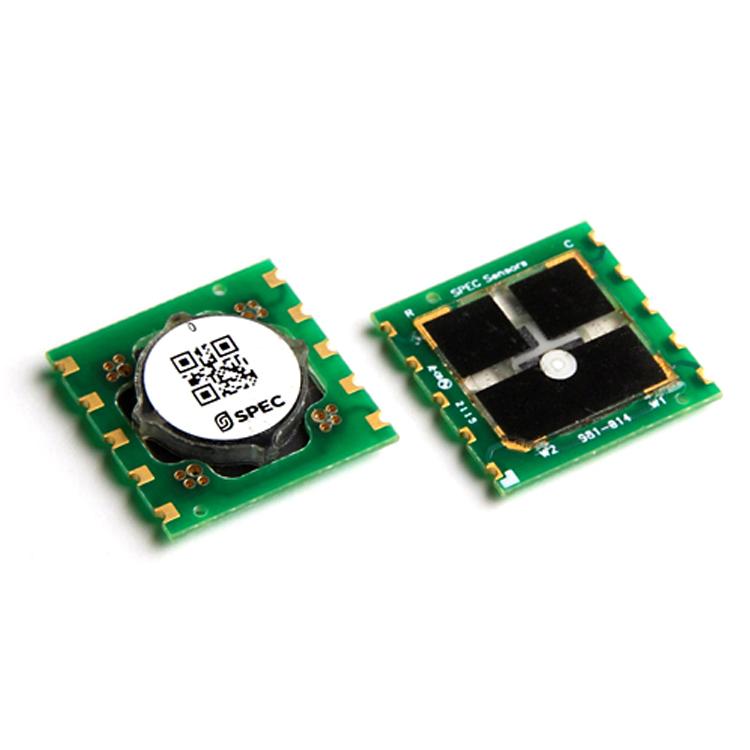

US SPEC Sensors Compact Air Quality Sensor - IAQ-100
Zero power sensor
Sensor power < 10 uW
Low temperature operation - no heating required
Durable design - not corroded by sulfides, alcohols, NH3
Stable response - unaffected by humidity, CO2, N2, Ar, most saturated hydrocarbons, n-hexane
Small size, low profile (20x20x3.0mm)
Sensitive - in ppm range
Easy to use - linear response
Long life - 10 year expected life
Fast response - < 20 seconds
RoHS certified
Product Introduction
1. Description of Air Quality Sensor IAQ_100:
SPEC's IAQ_100 sensor is a screen-printed electrochemical sensor designed for broad detection of gases related to poor air quality: sulfides, alcohols, ammonia, odorous gases, and carbon monoxide.
2. Features of Air Quality Sensor IAQ_100
- Zero power sensor
- Sensor power < 10 uW
- Low temperature operation - no heating required
- Durable design - not corroded by sulfides, alcohols, NH3
- Stable response - unaffected by humidity, CO2, N2, Ar, most saturated hydrocarbons, n-hexane
- Small size, low profile (20x20x3.0mm)
- Sensitive - in ppm range
- Easy to use - linear response
- Long life - 10 year expected life
- Fast response - < 20 seconds
- RoHS certified
3. Applications of Air Quality Sensor IAQ_100
• Poor air quality monitoring
• Indoor air quality detection
• Air purifier control
• Weather stations
• Internet of Things
• Smart home
• Early fire detection
• Leak detection
• HVAC
4. Important Notes for Air Quality Sensor IAQ_100
All sensors are designed for air monitoring at 1 atmosphere +/- 0.2 atmospheres. Since the application and device implementation are beyond our control, we cannot guarantee sensor performance specifications in a given device or application without assuming any liability. Customers should test under their own conditions to ensure the sensor meets their requirements.Contact the factory to discuss specific issues that may damage sensor performance or lifespan.
• Condensation (1)
• Saltwater contamination (1)
• High operating temperature (>70°C) for more than 1 month
• Low humidity operation (<15% RH) for more than 3 months
• High bias voltage
• Prolonged exposure to highly polluted air environments
• High concentration of particles or dust (unless proper filtration is used)
(1) Using a porous PTFE membrane or filter cap can solve this issue.