Product Introduction
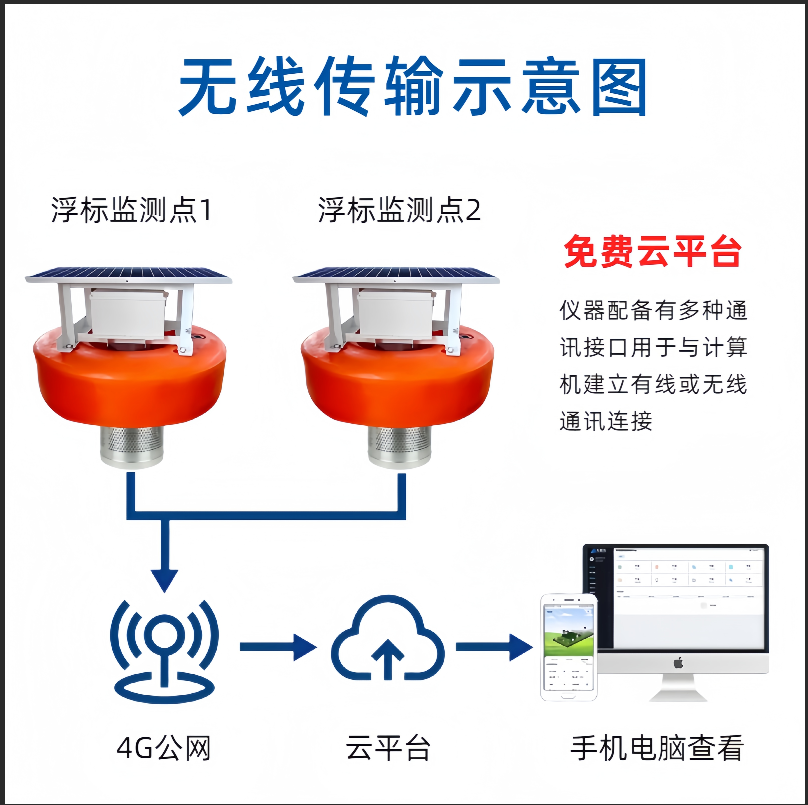
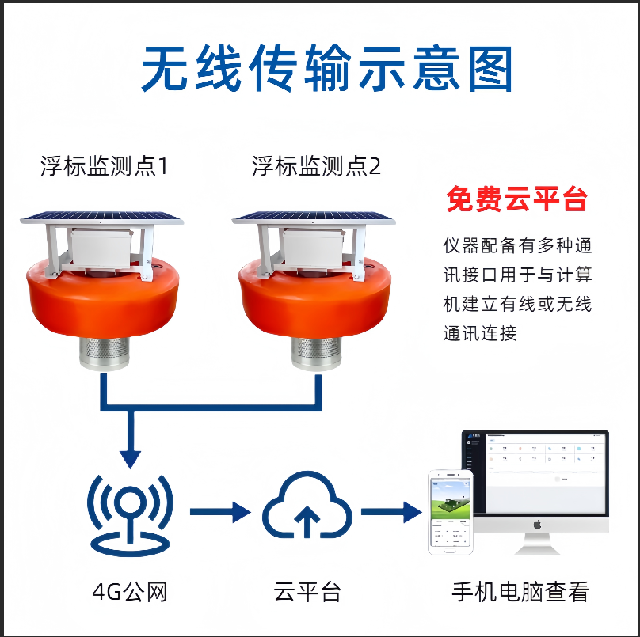
A buoy water quality monitoring system (buoy-type online water quality monitoring station) isIn-situ floating, unattendedwater environment monitoring equipment, commonly known as the water quality sentinel on water. Deployed on the water surface, anchored and fixed,7×24 hours of continuous water quality parameter collection, wirelessly transmitted to the cloud platform, enabling real-time monitoring and超标预警.
1. System composition AMT-FB301
- Buoy Body + Anchor and counterweight The buoy body is mostly made of polyethylene material, resistant to corrosion, wind, and waves; the bottom is equipped with a sensor bracket and counterweight; anchor rope + Sinker fixes the position to prevent drifting.
- Water Quality Sensor (Underwater Probe) Conventional five parameters:Water temperature,pH、溶解氧DO, turbidity, conductivity; Expansion:ORP, ammonia nitrogen,UVCOD, chlorophyll, blue-green algae, total phosphorus, total nitrogen; optional underwater camera. Sensors are often equipped with automatic cleaning brushes to reduce biofouling and lower maintenance frequency.
- Collection and Control Unit (Collector) The system brain, receiving sensor signals, filtering and processing, local storage, setting collection cycles, and supporting resumable data transmission.
- Power Supply Module Solar Panel + Lithium Batteryas the main power source, without external utility power; the buoy features low power consumption, suitable for long-term field operation.
- Communication Module 4G/5G/NB-IoT, coastal areas; satellite communication can be used for open seas; data uploaded to cloud platform.
- Cloud monitoring platform WEB / Mobile PhoneAPP, view real-time data, historical curves, and reports; customize thresholds, and receive SMS alerts for exceedances/ Platform pop-up alerts; supportsGPS Locate the buoy position.
II. Working principle
The sensor is immersed in water, converting physical and chemical signals of water quality / Chemical signals into electrical signals; the collector processes the signals; the communication module uploads data to the cloud platform; the platform automatically stores, analyzes, and provides warnings.
Electrochemical electrodes:pH, dissolved oxygen; optical principles: turbidity, chlorophyll, blue-green algae; UV method: COD.
III. Application Scenarios
- Drinking Water Source Reservoirs and Lakes
- Urban Rivers, Black and Odorous Water Treatment
- Aquaculture (warning for hypoxia, algal blooms)
- National surface water assessment / Provincial Control Sections
- Coastal Harbors, Estuary Marine Monitoring
- Sewage outlets, landscape lake water quality monitoring
IV. Core Advantages
✅ In-situ real-time continuous monitoring: Compensates for the shortcomings of manual sampling, which has low frequency and cannot capture sudden pollution events ✅ Easy deployment: No civil construction required, no cables needed. Simply deploy and anchor, and the monitoring point can be flexibly adjusted ✅ Unattended: Solar-powered, remote viewing, remote parameter configuration ✅ Rapid pollution warning: Automatic alerts when indicators exceed standards, enabling timely response to sudden pollution and cyanobacteria blooms ✅ High cost-effectiveness: Compared to fixed water quality stations, it has lower construction costs
Main Application Areas
- Environmental Monitoring — Continuous tracking of water quality in rivers, lakes, and reservoirs to detect pollution events and assess ecosystem health.
- Aquaculture — Monitoring of dissolved oxygen, pH, and temperature in fish farms to optimize conditions and prevent losses.
- Drinking Water Source Protection — Real-time surveillance of raw water quality in reservoirs and intake points to ensure safety and early warning of contamination.
- Industrial Discharge Monitoring — Verification of compliance with discharge regulations by monitoring effluents from industrial facilities.
Keywords:buoy water quality monitoring system, floating water quality station, real-time water monitoring, water quality sensor buoy, remote water quality monitoring, AMT-FB301, water quality telemetry, surface water monitoring