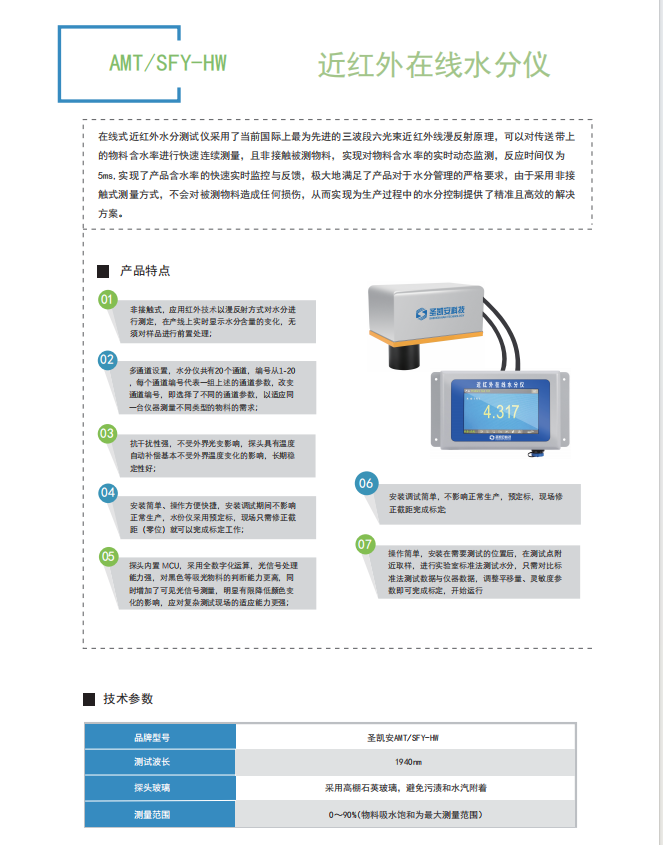
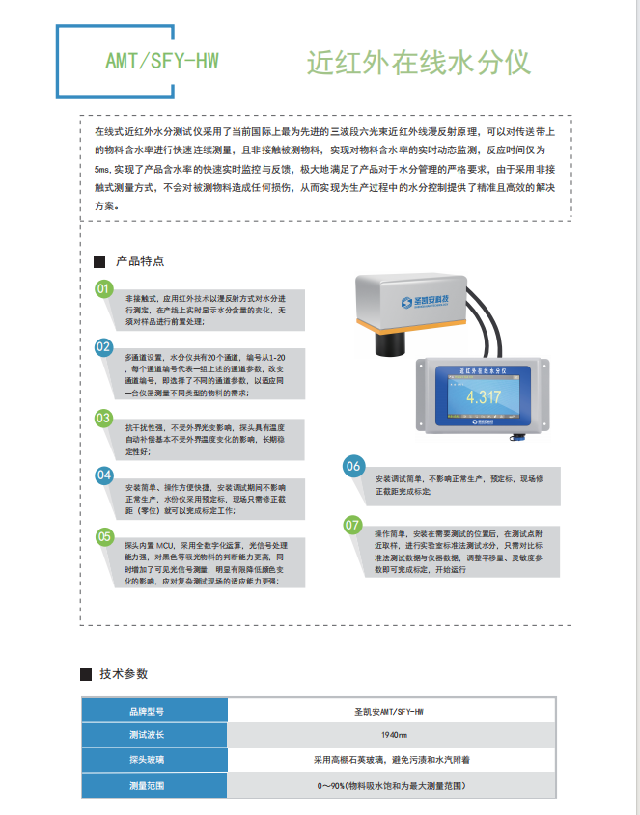
Thermogravimetric Infrared Moisture Analyzer - AMT/SFY-HW
Infrared moisture meters are divided into two major categories:Infrared Heating Gravimetric Type (Laboratory Benchtop)、Near-Infrared Spectroscopy Type (Online / Handheld, non-contact), the two principles are completely different, and many people easily confuse them.
Product Introduction
Infrared Moisture Meter
Infrared moisture meters are divided into two major categories:Infrared Heating Gravimetric Type (Laboratory Benchtop)、Near-Infrared Spectroscopy Type (Online / Handheld, non-contact), the two principles are completely different, and many people easily confuse them.
I. Two Principles
1. Infrared Heating Moisture Meter (Thermogravimetric Method)
Benchtop laboratory instrument, similar in principle to halogen moisture meters, heating source is infrared lamp / infrared tube.
- Principle: Infrared radiation heats the sample, moisture evaporates, built-in balance weighs the difference before and after heating to calculate moisture content.
- Testing Time:3 15 min。
- Advantages: Low cost, simple operation;
- Disadvantages: Sample is destroyed; other volatile substances in the sample are counted as moisture, leading to higher results; not suitable for materials that decompose at high temperatures.
2. Near-Infrared Spectroscopy Moisture Meter (NIR, Industrial Online / Handheld)
Non-contact, non-destructive, most commonly used on production lines.
- Principle: Water molecules O H Bonds to specific near-infrared wavelengths (1.94 μm etc.) have strong absorption; instrument emits multi-wavelength infrared light to irradiate material, measures reflected light intensity; adoptsDual / Three-Wavelength CompensationEliminates interference from material color and roughness, converts to moisture content.
- Features:Does not contact or damage the sample, milliseconds Results in seconds, can monitor continuously online。
- Disadvantages:Must be calibrated, different materials require establishing corresponding calibration models; affected by material thickness and surface condition; can only measure moisture at a certain depth on the surface.
II. Instrument Classification
- Benchtop Infrared Heating Moisture Meter: Laboratory, grains, feed, plastic pellets, medicinal herbs, pastes; sampling test, sample is dried and destroyed.
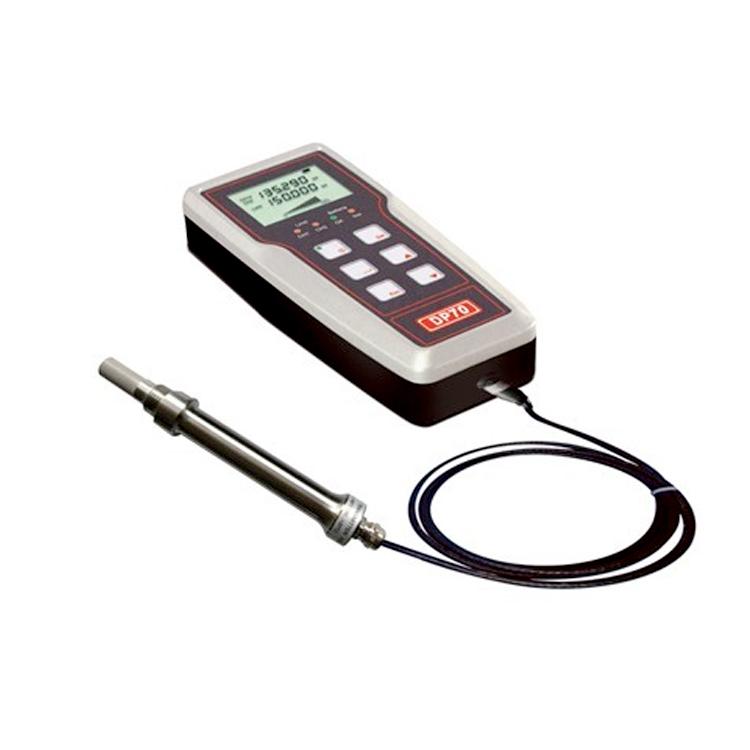
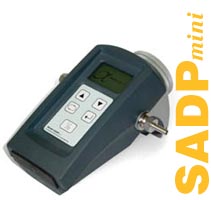
- Handheld Near-Infrared Moisture Meter: On-site rapid spot checks, non-destructive.
- Online near-infrared moisture meter: Probe type on production line, installed above conveyor belt, real-time output 4 20mA/RS485 Signal, can be linked with drying equipment for closed-loop production control, papermaking, tobacco, coal, food, building materials, chemical powders.
III. Main Industry Applications
- Grain and Feed: Cereals, Flour, Feed Pellets
- Food and Tobacco: Tea, Milk Powder, Tobacco Shreds, Baked Goods
- Papermaking and Textiles: Paper, Paperboard, Textiles
- Building Materials and Chemicals: Coal Powder, Ore, Fertilizers, Various Powders and Granules
- Pharmaceuticals: Traditional Chinese Medicine Slices, Granular Materials
IV. Pros and Cons Comparison
Infrared Heating (Thermogravimetric)
✅Advantages: Simple principle, close to oven method, no complex modeling needed; low cost.❌Disadvantages: Slow testing; sample destruction; volatile substance interference; can only sample and test in laboratory, cannot be used online.
Near-Infrared Spectroscopy Type
✅Advantages:Non-destructive, extremely fast, can measure continuously online, sample can be retained and reused。 ❌Disadvantages: High procurement cost; each material type requires calibration against the oven method; affected by surface, dust, and steam; measures surface moisture only.
V. Key Precautions
- Calibration is the core: Near-infrared models must be calibrated using the oven method (national standard); recalibration is required when changing materials, and general curves have large errors.
- Online probe: Avoid strong light, steam, dust; clean lens regularly; material thickness uniform, light spot fully covers material surface; probe installation height according to manual.
- Heating Type: Spread sample evenly with uniform thickness; heating chamber is high-temperature, beware of fire and burns; use with caution for volatile and heat-sensitive samples.
- Environment: Avoid direct strong light, large vibrations, voltage fluctuations; fully preheat before testing.
Main Application Areas
- Laboratory Analysis — Used in research and quality control labs for accurate moisture content determination in samples.
- Food Industry — Monitors moisture in food products to ensure quality and shelf life.
- Chemical Industry — Measures moisture in powders and granules to maintain product consistency.
- Pharmaceutical Industry — Ensures moisture levels in raw materials and final products meet regulatory standards.
Keywords:infrared moisture analyzer, moisture analyzer, thermogravimetric moisture analyzer, NIR moisture analyzer, laboratory moisture analyzer, online moisture analyzer, handheld moisture analyzer, moisture analyzer manufacturer