Product Introduction
Infrared Moisture Meter
Note: The market calls it "Infrared moisture meter" is divided into two types, with completely different principles, easily confused. 1)Infrared heating loss-on-drying type (benchtop laboratory): infrared lamp tube heating for drying + weighing, thermal loss-on-drying method; 2)Near-Infrared Spectroscopy Type NIR (mainly online): characteristic infrared absorption of water molecules,Non-contact, non-destructive, no heating, used on industrial production lines.
1. Infrared heating loss-on-drying moisture meter (benchtop, laboratory)
Principle
Infrared heating tube radiates heat to the sample, moisture evaporates due to heat, and the moisture content is calculated from the weight difference before and after drying, consistent with the oven method in principle, except that infrared radiation is used as the heat source.
Features
- ✅Simple operation, low price;3 15 Results in minutes;
- ❗Infrared heats the surface layer with shallow penetration; thick, dense samples tend to be dry outside but wet inside; if temperature is too high, samples may decompose or volatilize, leading to high results.
Main interference / Sources of error
- Improper temperature setting: if temperature is too high, organics and volatile components volatilize, leading to high results; if temperature is insufficient, moisture is not fully evaporated, leading to low results.
- Ambient air flow blowing directly: hot air / Cold air blowing directly on the weighing pan causes weight reading drift; a wind shield is required.
- Weighing system drift: requires periodic metrological verification; residual carbonized matter on the sample pan and heating window blocks infrared radiation, causing uneven heating.
- Sample state: sample spread too thick or clumped, internal moisture cannot escape; sample particles too large.
- Severe fluctuations in ambient temperature and humidityAffects the weighing unit of the balance.
Applicable to: grains, feed, plastic pellets, powders; not suitable for easily decomposable or highly volatile samples.
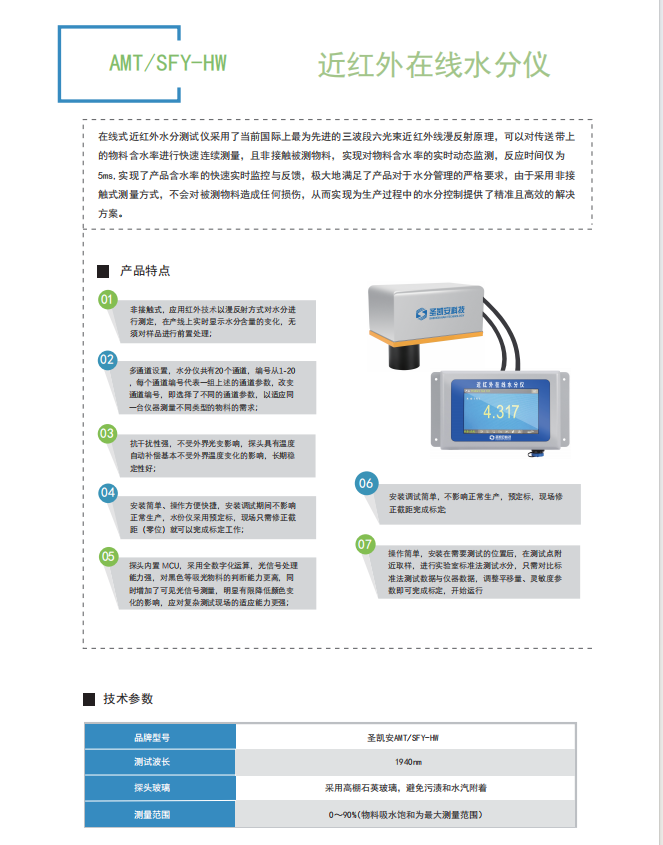
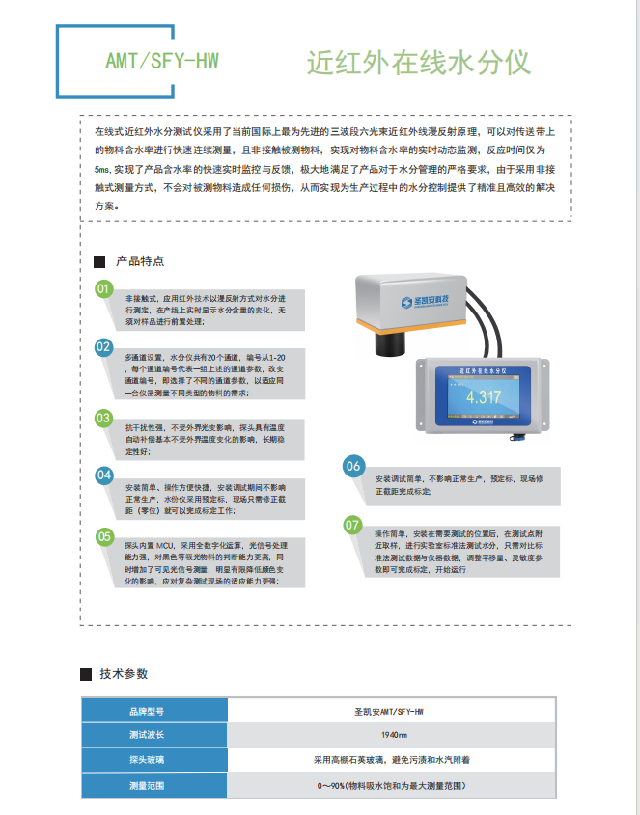
2. Near-infrared NIR spectral infrared moisture meter (mainly online industrial)
Principle
Water molecules in1.45μm、1.94μmhas strong infrared absorption peaks; the instrument emits specific wavelength infrared light to irradiate the material, measures the intensity of reflected light, and uses a reference wavelength for differential calculation to convert to moisture content,Does not damage samples, no sampling needed, non-contact, millisecond response, mostly used for continuous detection on conveyor belts and production lines.
Core:is a relative measurement; standard methods (oven / Karl Fischer) for calibration and modeling; cannot directly measure absolute moisture without calibration。
Structure
Light source, filter / Spectroscopic module, detector, signal processing, calibration model library.
Typical applications
Papermaking, textiles, grains, feed, chemical powders, building materials, pharmaceutical granules, tobacco leaves; installed above conveyor belts and chutes for real-time online moisture monitoring.
Interference factors (key point, most prone to issues on site)
1. Interference from the material itself (largest source)
1)Changes in material color, gloss, roughness, and particle size: changes infrared reflectance, directly causing reading drift; if the particle size of the same material changes, data will deviate; 2) Changes in material components: oils, proteins, starches, hydroxyl-containing organics also absorb in the near-infrared region, causing cross-interference with moisture signals;3)Material temperature variation: the infrared absorption peak of water shifts; if material temperature fluctuates without temperature compensation, moisture readings will deviate significantly; 4) Material thickness, layer thickness: if the layer is too thin/ Thickness fluctuations cause changes in reflected light intensity; if the material on the belt varies in thickness, readings will jump.
Main Application Areas
- Laboratory Analysis — Used in research and quality control labs for precise moisture determination in samples.
- Food Industry — Measures moisture in food products like grains, powders, and processed foods to ensure quality and shelf life.
- Chemical Industry — Determines moisture content in chemical powders, granules, and pastes for process control.
- Pharmaceutical Industry — Ensures moisture levels in raw materials and finished products meet regulatory standards.
Keywords:infrared moisture meter, moisture analyzer, halogen moisture analyzer, moisture balance, moisture determination, moisture content tester, industrial moisture meter, AMT/SFY-HW