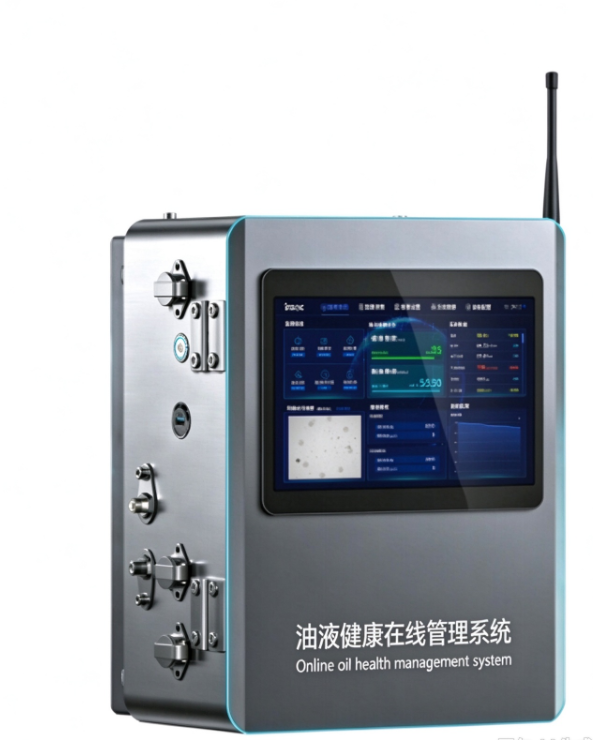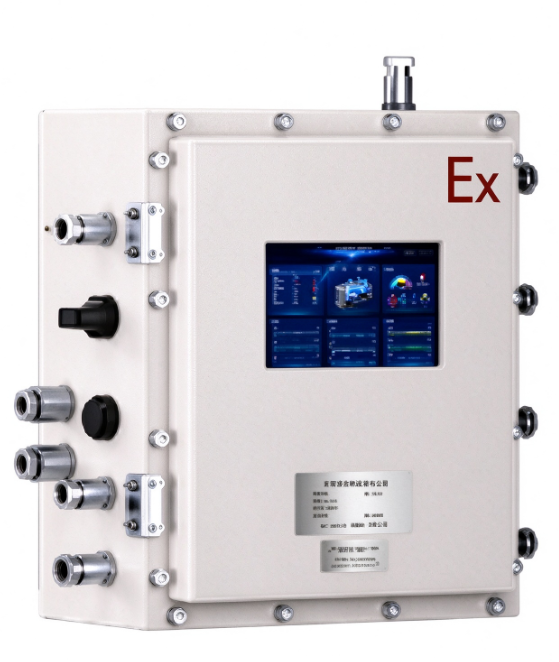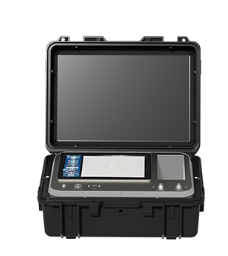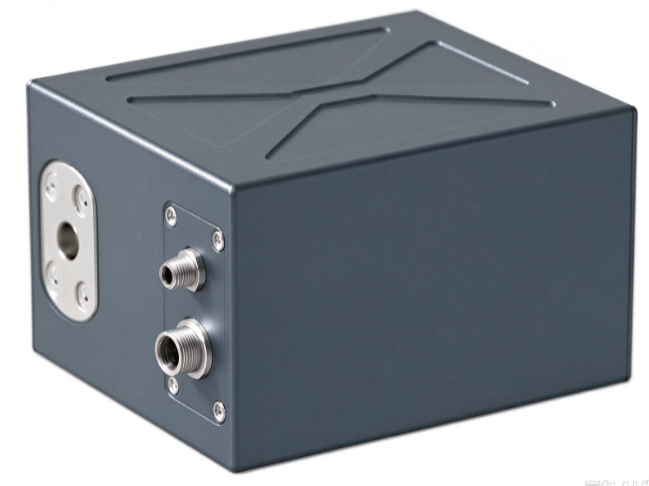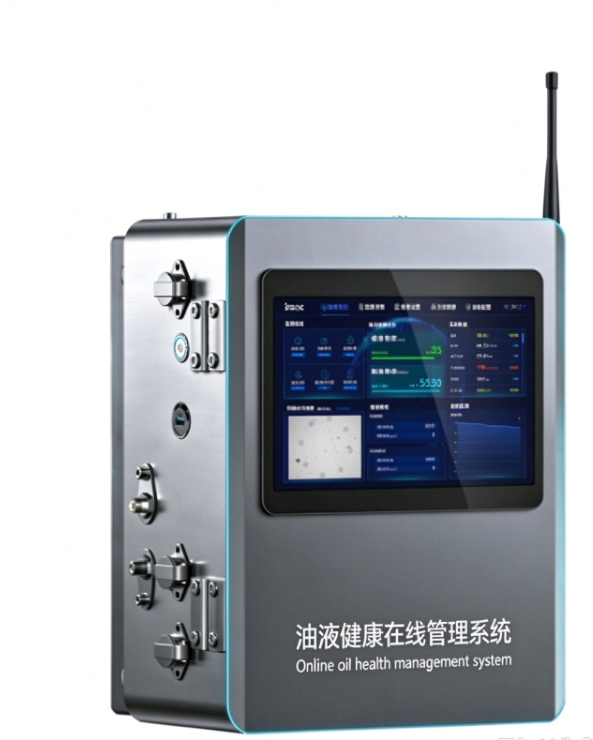
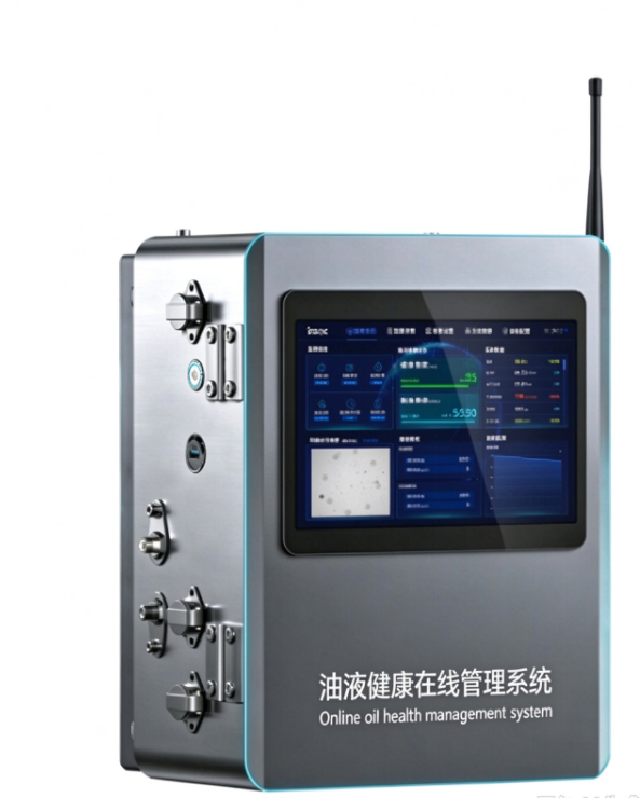
Oil Health Online Management System - SKA IOL-H4 Series
| Item | Parameter |
|---|---|
| Working method | Fully automatic |
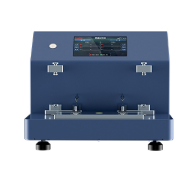
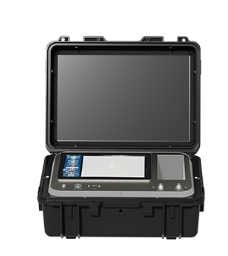
| Display mode | 10-inch industrial-grade touch screen (1920*1080) |
| Circulation Mode | Automatic cyclic sampling (built-in pump/external pump optional) |
| Communication method | 4G/5G/WIFI/Ethernet port/RS485/232/optical fiber |
| Cloud Platform | WeChat Mini Program/Web Portal |
Health Management (Standard)
| Item | Parameter |
|---|---|
| Health Indicators | Oil degradation factor, oil remaining useful life, oil health index |
| Monitoring Range | Health Index (0-100), Remaining Useful Life (0-10000 calibrated for different oils) |
Product Introduction
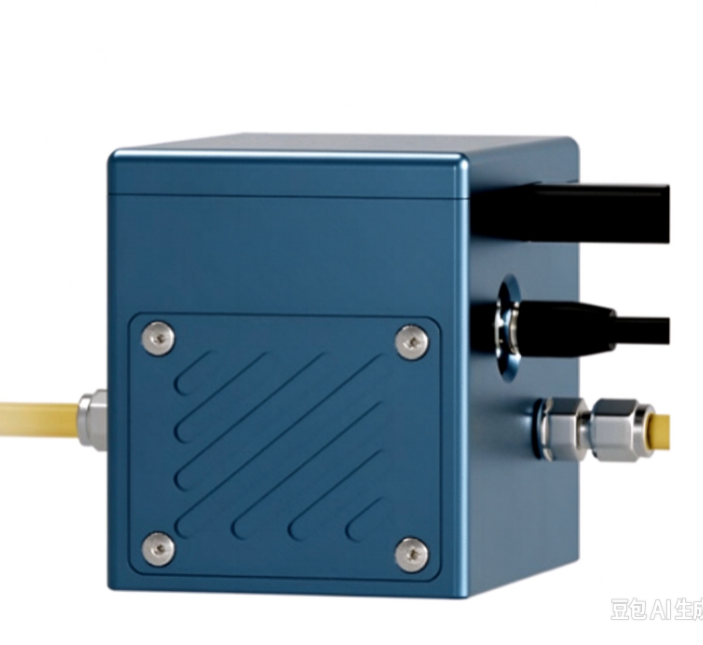
A new generationSKA IOL-H4 SeriesIntelligent online oil monitoring system is an industrial-grade smart terminal integrating "multi-dimensional sensing, edge modeling, and life prediction." The product core relies on a digital dynamic control platform and multi-physics composite sensor array, deeply integrating an edge computing-based oil health index (HI) evaluation model. Its technical highlight lies in the original four-dimensional fusion predictive algorithm: through normalization logic, viscosity decay, chemical aging (Tan Delta), moisture ingress, and wear particle indicators are uniformly converted into health penalty coefficients. The system uses the least squares method to perform linear regression analysis on historical data windows, precisely fitting the degradation slope and real-time estimating remaining useful life (RUL). Combined with adaptive baseline calibration (AC) and persistent data architecture, the system can automatically identify the initial physicochemical characteristics of different oils, achieving a generational leap from basic condition monitoring to precise predictive maintenance.
The system consists of four independent modules: perception layer, data processing layer, core algorithm layer, and application display layer. The sensor module supports hot-swapping and self-identification, and can be flexibly configured or individually upgraded according to different equipment and oil requirements
-
Supports flexible combination of viscosity, moisture, wear, contaminant particles, image recognition, ferrography, resistivity and other indicators
-
Full-series sentinel assistance mechanism, comprehensive self-diagnosis
-
Supports the new generation AI diagnostic module
-
Adaptive Analysis
-
Adaptive Baseline Calibration (AC):Supports one-click baseline reset after equipment installation or oil change, automatically capturing the initial physical characteristics of the current oil
-
Edge Computing Engine:Adopts an embedded low-level architecture, supporting cascaded processing of per-second sampling filtering and hourly trend modeling.
-
Model Management
-
Supports remote firmware upgrade (OTA), continuous algorithm optimization
-
Future expansion of prediction models for different oils or equipment without hardware replacement
-
Algorithm modules can be reused in various industrial scenarios (hydraulic systems, gearboxes, steam turbines, compressors, etc.)
-
Multi-physics Sensor Array:Integrates a high-resolution image sensing module, capable of precisely identifying micron-level wear particle morphology characteristics and contaminant distribution.
-
Hardware Advantages
◼ 4-core + 12TOPS computing architecture (new)
SKA IOL-H4The system is equipped with a high-performance industrial-grade main control platform, with the core processor using RK series chips. This chip is based on4×Cortex-A72 + 4×Cortex-A53 big.LITTLE heterogeneous architecture, with a main frequency of up to 2.2GHz, balancing high-performance computing and low-power control, perfectly matching edge intelligent computing needs. The system is equipped with 4GB/8GB high-bandwidth memory and 128GB eMMC storage, providing ample resources for multi-sensor real-time data acquisition, complex algorithm fusion, and smooth graphical interface operation. The computing part can reach12TOPS NPUNeural network processor, providing powerful computing support for AI artificial intelligence prediction models.
-
-
Main Application Areas
- Industrial Gearboxes — Continuous monitoring of gear oil health to prevent unexpected failures and extend oil change intervals.
- Hydraulic Systems — Real-time detection of oil degradation, water contamination, and wear particles in hydraulic power units.
- Wind Turbines — Remote oil condition monitoring for wind turbine gearboxes and hydraulic systems to reduce maintenance costs.
- Marine Engines — Online oil analysis for marine diesel engines to ensure reliable operation and optimize maintenance schedules.
- Power Generation — Oil health management for gas and steam turbine lubrication systems to improve availability and reduce downtime.
Keywords:oil health monitoring system, online oil analysis, oil condition monitoring, oil life prediction, industrial oil sensor, oil degradation monitoring, predictive maintenance oil, oil health index